

TIME: THE GREATEST MYSTERY IN THE UNIVERSE

Our understanding of the true nature of time has barely advanced since Einstein merged space and time into a single, four-dimensional physical entity more than a century ago. Despite this fact, space and time behave differently: time flows forward irreversibly.
In this article, we'll analyze the mystery of time from the perspective of quantum mechanics and string theory, and we'll explore some astonishing clues about its nature.
Welcome to the depths of the greatest mystery in the Universe: the true nature of time!
The Minkowski metric of our space-time
In the Euclidean metric all components take positive values: ds2=dt2+dx2+dy2+dz2. However, our Universe has Lorentz symmetry and therefore has the Minkowski metric: ds2=-dt2+dx2+dy2+dz2.
Here we can already see the first difference between space and time: from the point of view of the Minkowski metric, space "squares" positive values, while time "squares" negative values. The Minkowski metric reflects the difference between the distance "traveled" in space and the distance "traveled" in time. In the case of a body at rest (approximately like ours), this metric is dominated by the
Time ds2 = -dt2 and will therefore be negative. In the case of light, the metric will be exactly 0. Three types of interval can be distinguished:
- If the metric is negative, the interval is "time-like." The distance in time is greater than the distance in space. This is the interval corresponding to all particles with mass that always travel at a speed less than the speed of light. There is a causal connection.
- If the metric is zero, the interval is "light-like." The distance in space is equal to the distance in time (this corresponds to 45º in the space-time diagram). This is the interval corresponding to a light ray.
- If the metric is positive, the interval is "space-like." The distance in space is greater than the distance in time, so light doesn't have time to travel the spatial interval, and there is no causal connection.
Time and quantum mechanics
Some physicists believe that the nature of time may be the true cause of the "strange" characteristics of quantum mechanics (superposition and entanglement). In quantum mechanics, the probability amplitude of the transition from one vacuum to another is given by the following expression:

Where L(Ø) is the Lagrangian. The integral is performed by summing over all possible trajectories of the field configurations. Quantum theories that describe known particles and their interactions are called quantum field theories (QFTs). The problem is that when we use a QFT, the integral in the above expression is not well-defined and cannot be calculated. However, if we perform an analytical continuation considering the entire "complex time part," that is, if we allow time to take complex values by taking t´= -it, then the above expression becomes:

Now the integral is calculable and produces the correct result of the partition function for a QFT with temperature T=h. That is, the only way to obtain the correct result is to allow time to take complex values. Let us now consider a massive particle with mass m, the probability amplitude
propagation of the particle from point A to point B is:

Where ds=√-dt2+dx2. Again we must consider all possible trajectories between A and B, this is one of the strangest features of quantum mechanics, it is as if the particle took all possible trajectories such that the probability amplitudes of all of them interfere constructively or destructively leaving only the most probable trajectories. Let's now look at something quite remarkable: in space-like trajectories the square root is positive and therefore the amplitudes are real and there is no interference, however, for time-like trajectories the square root is negative, the amplitudes are complex and quantum interference occurs. Here we have our first "clue" about the nature of time: Is time responsible for the "superposed" nature of the quantum world?
Singularities in time
One of the most striking predictions of general relativity is the existence of space-time singularities. These singularities can be located in space (time-like singularities) or in time (space-like singularities). One of the goals of theories aspiring to quantum theories of gravity is to attempt to resolve these singularities. Using superstring theory, we can resolve many of these singularities primarily through three mechanisms:
- D-branes . Branes and strings are the fundamental entities of superstring theory. D-branes behave like solitons or "sources" of spacetime and are where the ends of open strings are "born" and "dead." Under certain conditions, D-branes occupy the site of the singularity, thus avoiding discontinuities in spacetime.
- Topological transitions. Under certain conditions, changes in the topology of space-time occur, resulting in the elimination of the singularity.
- New degrees of freedom or new geometries. Certain models of string theory predict that when the energies involved are very large, branes interact with the background (spacetime), giving rise to new geometries and new degrees of freedom. Furthermore, some branes are unstable, and their decay can produce a radiation of closed strings that are the "fingerprint" of the emergence of new configurations of spacetime.
Unfortunately, all the singularities that can be resolved with these mechanisms are always singularities in space, not time. However, the most interesting singularities are singularities in time.
like the Big Bang or those found in black holes formed by stellar collapse. Here we have our second "clue": Is it possible to resolve singularities in time? What would these solutions tell us about the
The nature of time? There are already some proposals to try to resolve singularities in time: the so-called SD-branes are "space-like" branes that behave as "defects" in time and are quantized by open strings fixed to their surface. In some of these models, an unstable brane is located at the "beginning of time" and, upon decay, produces a "background" of closed strings that are associated with new geometries. There are works in this direction that use the AdS/CFT duality to hope to identify the modes.
of the lightest vibrations of these branes with the first moments of time, thus identifying the "birth of time" from a state without previous time.
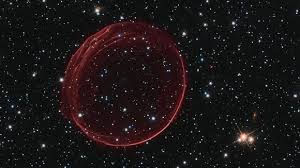
Bubbles of "nothing" and the origin of time
One theoretical way to analyze the origin of time would be to start from a Universe without time and study whether it is possible to generate some physical process that leads to a Universe like ours where time flows irreversibly.
Although it may seem like something out of a science fiction movie script, "bubbles of nothing" appear naturally in certain space-times studied by string theory. In 1982, physicist Edward Witten showed that a Universe with negative curvature (AdS Universe) and with an additional dimension curled into a circle is unstable. This instability causes the Universe to undergo a topological phase transition (a change in the topology of space-time), which causes the formation of a "nothing hole." This hole literally contains nothing: no matter, no energy, no quantum fields , it doesn't even contain space-time! Then this "bubble of nothing" begins to expand and reaches the size of the entire Universe. Roughly speaking, it is as if we had a Universe shaped like a
donut and due to a topological change the hole in the donut, which doesn't even contain space-time (a hole of nothing), began to expand, swallowing the entire volume of the original Universe. Now we literally have a Universe of nothing!
By AdS/CFT duality, we know that an AdS Universe is dual to a conformal quantum theory residing at its edge. What happens if we analyze this topological change to a nothing Universe in the dual theory? What we find is that in the dual theory, the only thing that happens is a phase change. This phase change "disrupts" the ordered state of quantum theory that would "produce" the "flow" of time in the AdS Universe. This brings us to the fourth and final "clue": Does time arise as a consequence of an ordering of the fundamental degrees of freedom in the dual theory?
This leads us to a disturbing question: Could time stop, reverse, or even disappear (producing a bubble of nothingness) if this underlying order is disrupted? These questions lead us to a fifth "clue" about the nature of time. Because of its importance and scope, it will be analyzed in the next article on this website.
Conclusions
When it comes to the nature of the temporal dimension and its origins, we still have many more questions than answers. However, there are tantalizing hints that the flow of time may be an emergent property derived from an ordered phase of degrees of freedom or "underlying fundamental components." Some studies seem to indicate that the temporal singularity we call the Big Bang was due to a phase shift in dual quantum theory, which could mean that the origin of our Universe is just one part of a "common" process that has happened and will happen across the board. Perhaps our Universe is just one of many, perhaps it is just a tiny part of something much larger that has always existed and will exist forever... Can modern physics solve the problem of the origin of time?
Sources: What we don't know about time


Comments